
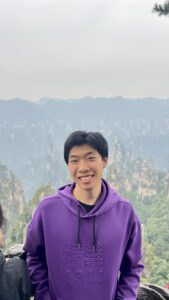
 Shunshi IZUMI
2024 cohort
Tsinghua University
Shunshi Izumi grew up across cultures, but it was not until his exchange year at Tsinghua University that he truly found his voice. In Beijing, he was encouraged to be open, honest, and direct – an experience he believes revealed his calling to be a “middleman” that bridges cultures, people, and technologies.
Born in Hawaii to a Japanese father and Chinese mother, and raised in Canada and Japan, Shunshi has long navigated multiple cultures. Now a final-year mechanical engineering student at the University of Tokyo, he jokes that he is an “atypical” Japanese or “California roll,” with an identity that blends his Japanese upbringing with a Western outlook and influences from his Chinese roots.
Moving from Vancouver to Osaka at a young age, Shunshi recalls how his “free and expressive” nature sometimes clashed with a collective culture that prioritized harmony and conformity. “I felt that nobody understood my perspective, and so I created a ‘shield’ to protect myself,” he says. It was not until his time at Tsinghua that he felt the freedom to shed this protective “shield”. Initially choosing to study abroad in China as a way to reconnect with his family heritage, Shunshi instead discovered an inviting space where he was able to open up and be comfortable in his own skin. “China has aspects of both Western and Japanese cultures,” he explains. “There are many social structures (like Japan), but people are more free and expressive, kind of like Canadians.” The Bai Xian community also encouraged him to share his perspectives and thoughts without fear of judgment. “With my fellow scholars, I felt like I could just be myself,” he says. “My peers were supportive, genuinely interested, and even encouraged me to take the next step. It was empowering to be around people who actually listened and believed in me.” Being in that environment, Shunshi believes, reshaped his communication style – he now aims to be more direct and concise, to lead with questions rather than assumptions, and to stay open and curious.
His AFLSP experience also influenced his academic and career aspirations. Immersed in China’s technology-infused lifestyle for a year, Shunshi came to see the importance of integration over invention, i.e., connecting existing tools to real human needs. He is applying to master’s programs in industrial engineering in the hopes of learning how to align technological logic with societal practicality, guided by a culturally sensitive lens that accounts for the needs of different cultures and societies. Between machines and people, China and Japan, structure and spontaneity, Shunshi is learning to inhabit the middle – where technology serves real needs and open dialogue becomes the first design decision.